How to plan a crypto portfolio for the next cycle in 2026 when everyone is still bullish
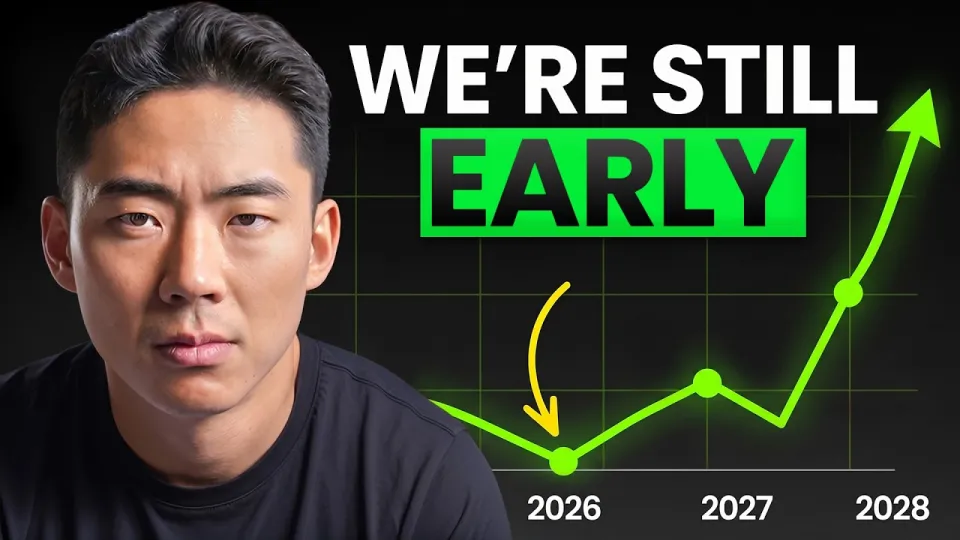
Video: my plan to make millions in crypto 2027
You can order the same kind of articles for your own video to boost it on YouTube and Google. Just message the Telegram bot @sat_sit_bot. The bot writes and publishes the articles itself (with your YouTube video embedded) on popular topical websites (no ads). Free trial — 50 articles.
Key takeaways
- Brian Jung's plan is built on a bull case for crypto heading into the next cycle, but he pairs it with explicit risk rules rather than all-in conviction.
- The narratives he tracks include Bitcoin as an institutional asset, Ethereum and Layer 2 scaling, and newer Layer 1 chains such as SUI.
- Comments on the video show the main failure mode: traders who went all-in on the previous cycle's top and lost most of their capital.
- A workable allocation splits capital into core holdings, narrative bets and a cash reserve, with a fixed maximum per altcoin.
- The plan is published as a product through Kaizen Pro, a paid research and community offering.
A crypto plan for the next cycle in 2026 should start from a written allocation, not from a price prediction: decide how much of your portfolio goes to Bitcoin, how much to Ethereum and large Layer 1s, how much to higher-risk narrative bets, and how much stays in stablecoins. Brian Jung's breakdown lays out exactly this kind of framework — a bull case for the market plus a set of rules for surviving it — and the full research product sits behind the Kaizen Pro waitlist, where the plan is packaged with market reports and community access.
Why the crypto bull case still has supporters in 2026
The core argument is that crypto is no longer a retail-only market: spot Bitcoin ETFs, corporate treasury buying and regulated custody have put a structural bid under the largest asset. That changes the shape of a cycle — drawdowns tend to be shallower and recoveries faster when institutional allocators are buying on schedule rather than chasing momentum.
The second leg of the argument is adoption of the rails. Stablecoins now move more value than many legacy payment corridors, tokenized treasuries and money-market funds have become a real product category, and Ethereum's Layer 2 networks have pushed transaction costs low enough for consumer apps. Each of these is a revenue-generating use case rather than a narrative without users.
The third leg is supply. Bitcoin's issuance schedule is fixed and the halving cycle continues to cut new supply, while a large share of coins sits in long-term custody or ETF vaults. When float is thin, marginal demand moves price disproportionately.
None of this removes risk. A bull case is a probability statement, not a guarantee, and the honest version of it includes the conditions under which it breaks: a regulatory reversal, a credit event among leveraged players, or a macro shock that forces institutions to sell liquid assets first.
The narratives driving the next cycle
Capital rotates between stories, and the stories with the most durable funding tend to outperform. Four narratives are worth tracking:
- Bitcoin as an institutional asset. ETF flows, treasury adoption and options market growth make BTC the default entry point for new capital. It is the lowest-variance way to hold the theme.
- Ethereum and the Layer 2 economy. Fees on rollups, restaking and tokenized real-world assets give ETH a cash-flow story that most chains lack.
- High-throughput Layer 1s. Chains such as SUI attract capital when users care about cheap transactions and consumer apps; they carry higher beta and higher risk than ETH.
- Infrastructure for real users. Stablecoin payments, on-chain lending and wallets that hide the complexity are where mainstream adoption actually shows up in usage data.
A useful filter for any narrative: can you name the users, the revenue and the competitor? If the answer is only a chart, it is a trade, not an investment.
My plan to make millions this cycle
The plan that survives contact with the market is boring in construction and aggressive only in position size. A workable version has four layers:
- Core (40–60%): Bitcoin and Ethereum, held through volatility, rebalanced only on large moves.
- Growth (20–30%): large Layer 1s and infrastructure tokens with real usage, capped at a set percentage per name.
- Venture-style bets (10–20%): smaller narrative plays where the expected value comes from a few winners, sized so that a total loss is survivable.
- Dry powder (10–20%): stablecoins held for drawdowns, because the best entries usually arrive when sentiment is worst.
Rules matter more than the allocation itself. Write down a maximum position size per altcoin, a rule for taking profits on the way up, and a rule for what would make you exit a thesis. The most common way traders lose in a bull market is not picking the wrong coin — it is holding a winner all the way back down because they never defined a sell.
Where most crypto plans fail
The biggest risk in a bull market is leverage plus conviction. Traders who borrow to press a thesis can be right about direction and still be liquidated by a wick, and the same pattern repeats every cycle: heavy altcoin exposure at the top, forced selling at the bottom, and no capital left for the recovery.
A second failure is concentration in last cycle's winners. The assets that led the previous run rarely lead the next one, because the marginal buyer has already been exhausted and the story is priced in. Rotating out of yesterday's leader requires admitting that the thesis worked and is now finished.
A third is treating a content creator's portfolio as a template. Someone with a long time horizon, a large risk budget and a public audience can hold through a 60% drawdown; most people cannot, and the honest move is to size positions to your own tolerance, not to theirs.
Typical questions from viewers
Viewers of the breakdown raise three recurring doubts. The first is whether regulatory clarity is actually bullish — the argument being that clearer rules could let banks and custodians dominate the market rather than decentralize it. The second is whether anyone can really predict a cycle top, with guesses ranging from the near term to several years out. The third is allocation: many people want a simple split, such as half the portfolio in altcoins, without a framework for which ones or how to exit.
A practical answer to all three is process over prediction. You do not need to call the top if you take profits in tranches, and you do not need to guess which chain wins if you cap the size of each bet. Regulatory clarity, meanwhile, is a net positive for adoption even if it changes who the biggest holders are.
Links and resources from the breakdown
- Kaizen Pro waitlist: https://whop.com/kaizen/products/kaizen-pro/
- Free crypto market report newsletter: https://newsletter.kaizen.gg/subscribe
- Brian Jung on X: https://twitter.com/thebrianjung
- Brian Jung on Instagram: https://www.instagram.com/creditbrian
- Risks and disclaimers document: https://docs.google.com/document/d/1WIgz8SB1mMzke0uvLt_6zXmSbqLL4gL5VgpDnVEk5m8/edit?usp=sharing
The takeaway
A crypto plan for the next cycle is a set of decisions made in advance: an allocation across core, growth and speculative buckets, a maximum size per altcoin, and a written rule for taking profits. Brian Jung's breakdown is useful because it pairs a bull case with those operational rules instead of selling a single price target. Treat the research as a starting point, size every position so a total loss does not change your life, and keep dry powder for the moments when the market feels worst. If you want the full framework, the Kaizen Pro waitlist is where the plan and the market reports live.
Source: my plan to make millions in crypto 2027 · Markdown version
Questions & answers
Is regulatory clarity actually bullish for crypto?
Clearer rules bring institutional capital, custody and insurance into the market, which raises total demand. The trade-off is that banks and regulated intermediaries may capture much of that flow, so decentralization-focused tokens could lag even as the overall market grows.
Can you predict the top of a crypto cycle?
Not reliably, and estimates vary widely from the near term to several years out. A more practical approach is to sell in tranches as prices rise and to define in advance what percentage of each position you will take off at each level.
How much of a crypto portfolio should be in altcoins?
A common split is 40–60% in Bitcoin and Ethereum, 20–30% in large Layer 1s and infrastructure, and 10–20% in smaller bets, with a cash reserve. The right number is the one where a 50–70% drawdown in the altcoin sleeve does not force you to sell.
What is the biggest mistake in a bull market?
Leverage combined with conviction. Being right about direction does not protect a leveraged position from a liquidation wick, and the result is often forced selling at the bottom with no capital left for the recovery.